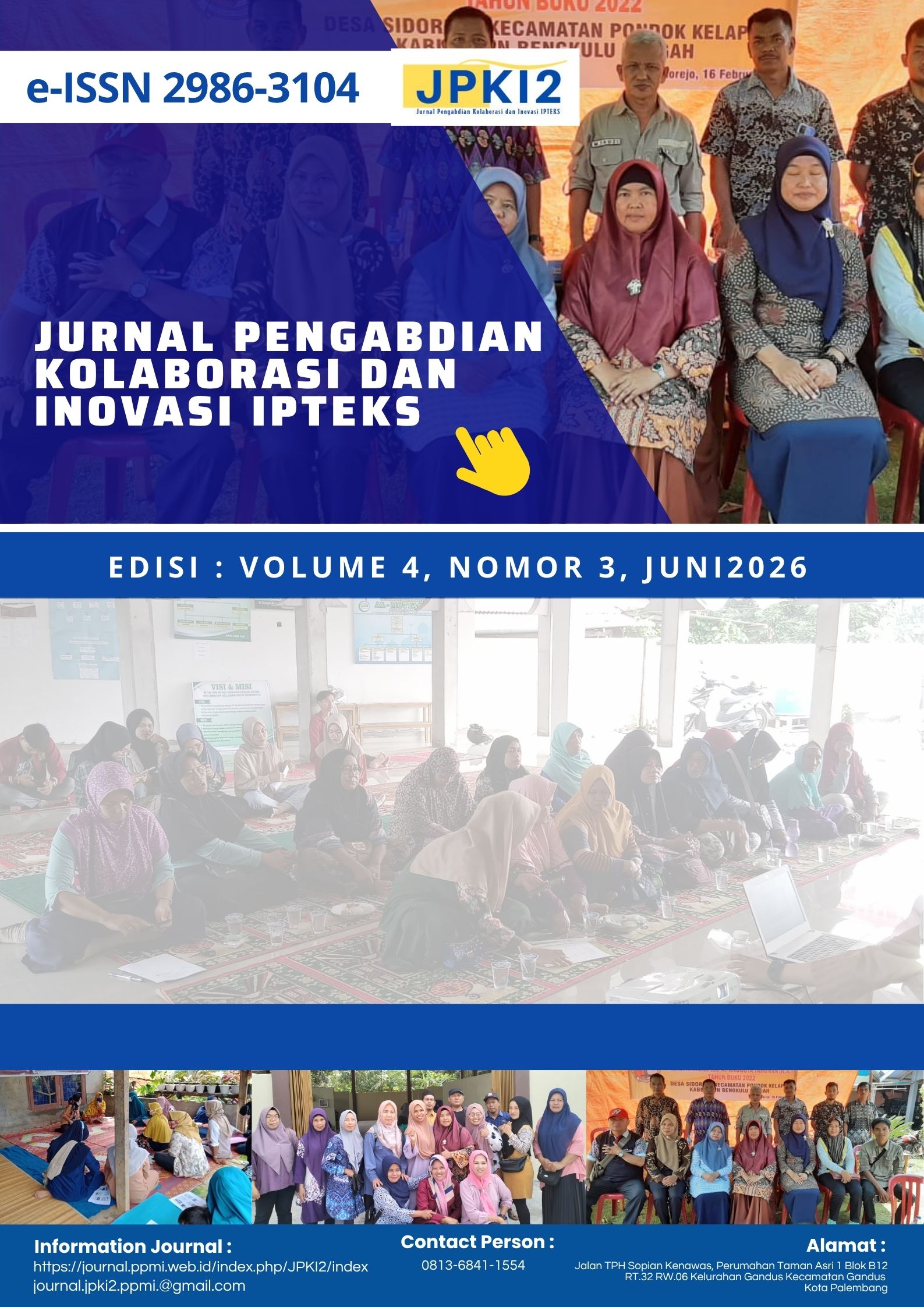
MENILAI RISIKO SARKOPENIA MELALUI KEKUATAN GENGGAMAN TANGAN: SKRINING DAN EDUKASI KESEHATAN PADA KOMUNITAS DEWASA SEKOLAH MUTIARA BANGSA
DOI:
https://doi.org/10.59407/jpki2.v4i3.3918Keywords:
dewasa produktif, handgrip strength, pengabdian kepada masyarakat, sarkopenia, skrining ototAbstract
Kegiatan pengabdian kepada masyarakat ini bertujuan menggambarkan kekuatan genggaman tangan (handgrip strength) sebagai indikator fungsi otot dan deteksi dini sarkopenia pada masyarakat dewasa produktif. Sarkopenia merupakan kondisi penurunan massa dan kekuatan otot yang berkaitan dengan proses penuaan serta peningkatan risiko penurunan fungsi fisik, disabilitas, dan penyakit metabolik. Pemeriksaan handgrip strength dipilih karena merupakan metode skrining yang sederhana, cepat, dan mudah diaplikasikan di komunitas. Sebanyak 45 responden mengikuti pemeriksaan menggunakan dinamometer, dilanjutkan dengan edukasi mengenai pentingnya aktivitas fisik, latihan resistensi, dan pemenuhan asupan protein untuk mempertahankan fungsi otot. Rerata usia responden adalah 34,69 ± 9,05 tahun dengan mayoritas berjenis kelamin perempuan (80,0%). Rerata nilai handgrip strength sebesar 26,89 ± 9,35 kg, dengan sebagian besar responden berada pada kategori normal, sementara sebagian kecil memenuhi kriteria sarkopenia. Temuan ini menunjukkan bahwa skrining berbasis komunitas mampu mengidentifikasi individu yang berisiko mengalami penurunan kekuatan otot meskipun sebagian besar peserta masih memiliki fungsi otot yang baik. Luaran kegiatan berupa hasil skrining individual yang disertai edukasi kesehatan diharapkan dapat meningkatkan pemahaman peserta mengenai pentingnya menjaga massa dan kekuatan otot sebagai upaya pencegahan sarkopenia sejak usia dewasa.
References
Affourtit, C., & Carré, J. E. (2024). Mitochondrial involvement in sarcopenia. Acta Physiologica, 240(3). https://doi.org/10.1111/apha.14107
Benz, E., Pinel, A., Guillet, C., Capel, F., Pereira, B., De Antonio, M., Pouget, M., Cruz-Jentoft, A. J., Eglseer, D., Topinkova, E., Barazzoni, R., Rivadeneira, F., Ikram, M. A., Steur, M., Voortman, T., Schoufour, J. D., Weijs, P. J. M., & Boirie, Y. (2024). Sarcopenia and Sarcopenic Obesity and Mortality Among Older People. JAMA Network Open, 7(3), e243604. https://doi.org/10.1001/jamanetworkopen.2024.3604
Blanquet, M., Ducher, G., Sauvage, A., Dadet, S., Guiyedi, V., Farigon, N., Guiguet-Auclair, C., Berland, P., Bohatier, J., Boirie, Y., & Gerbaud, L. (2022). Handgrip strength as a valid practical tool to screen early-onset sarcopenia in acute care wards: a first evaluation. European Journal of Clinical Nutrition, 76(1), 56–64. https://doi.org/10.1038/s41430-021-00906-5
Buckinx, F., & Aubertin-Leheudre, M. (2019). Relevance to assess and preserve muscle strength in aging field. Progress in Neuro-Psychopharmacology and Biological Psychiatry, 94, 109663. https://doi.org/10.1016/j.pnpbp.2019.109663
Chien, W., Lee, W., Liang, C., Yen, K., Peng, L., Lin, M., Loh, C., Hsiao, F., & Chen, L. (2025). Muscle‐Specific Strength Better Predicts Physical Performance Decline Than Conventional Metrics: The I‐Lan Longitudinal Aging Study. Journal of Cachexia, Sarcopenia and Muscle, 16(5). https://doi.org/10.1002/jcsm.70078
Chung, J. Y., Kim, S.-G., Kim, S. H., & Park, C. H. (2025). Sarcopenia: how to determine and manage. Knee Surgery & Related Research, 37(1), 12. https://doi.org/10.1186/s43019-025-00265-6
Du Rietz, M., & Beischer, S. (2024). Assessment of muscle strength in elderly as a screening method for sarcopenia in primary care: a scoping review. BMJ Open, 14(11), e085190. https://doi.org/10.1136/bmjopen-2024-085190
Hsu, N.-W., Lin, C.-H., Yang, N.-P., Chen, H.-C., & Chou, P. (2023). Handgrip strength is associated with mortality in community-dwelling older adults: the Yilan cohort study, Taiwan. BMC Public Health, 23(1), 2194. https://doi.org/10.1186/s12889-023-17058-9
Ji, S., & Jang, I.-Y. (2024). EXERCISE AND NUTRITION ON SARCOPENIA AND FUNCTIONAL SARCOPENIA: FINDINGS FROM RANDOMIZED CONTROLLED TRIALS. Innovation in Aging, 8(Supplement_1), 872–872. https://doi.org/10.1093/geroni/igae098.2820
Kim, G. S., Lee, J. J., Park, M. K., Kim, L., Kwon, S., Park, E. J., Yang, H., & Yang, S. (2025). Possible sarcopenia and associated factors in community-dwelling older adults with a history of falls in the Republic of Korea: a cross-sectional study. BMC Geriatrics, 25(1), 575. https://doi.org/10.1186/s12877-025-06248-2
Lee, D. H., Lee, H. J., Yang, G., Kim, D. Y., Kim, J. U., Yook, T. H., Lee, J. H., & Kim, H. J. (2024). A novel treatment strategy targeting cellular pathways with natural products to alleviate sarcopenia. Phytotherapy Research, 38(11), 5033–5051. https://doi.org/10.1002/ptr.8301
Lian, R., Jiang, G., Liu, Q., Shi, Q., Luo, S., Lu, J., & Yang, M. (2023). Validated Tools for Screening Sarcopenia: A Scoping Review. Journal of the American Medical Directors Association, 24(11), 1645–1654. https://doi.org/10.1016/j.jamda.2023.06.036
Liu, Z., & Zhu, C. (2023). Causal relationship between insulin resistance and sarcopenia. Diabetology & Metabolic Syndrome, 15(1), 46. https://doi.org/10.1186/s13098-023-01022-z
McBride, J. M., Bauer, E. C., Kaufmann, N. C., Triplett, N. T., & Shanely, R. A. (2025). Handgrip Strength Associated With Leg Strength, Power, and Muscle Mass in 18–64-Year-Old Males and Females. Journal of Strength & Conditioning Research, 39(6), 642–648. https://doi.org/10.1519/JSC.0000000000005089
Ogawa, S., Yakabe, M., & Akishita, M. (2016). Age-related sarcopenia and its pathophysiological bases. Inflammation and Regeneration, 36(1), 17. https://doi.org/10.1186/s41232-016-0022-5
Petermann‐Rocha, F., Balntzi, V., Gray, S. R., Lara, J., Ho, F. K., Pell, J. P., & Celis‐Morales, C. (2022). Global prevalence of sarcopenia and severe sarcopenia: a systematic review and meta‐analysis. Journal of Cachexia, Sarcopenia and Muscle, 13(1), 86–99. https://doi.org/10.1002/jcsm.12783
Santoso, A., Destra, E., Firmansyah, Y., & Lontoh, S. (2025). Impact of Glucose Profile, Fasting Insulin, and Renal Function on Sarcopenia in Elderly at Single Centered Nursing Home: A Cross-Sectional Structural Equation Model Analysis. Journal of Multidisciplinary Healthcare, Volume 18, 1393–1404. https://doi.org/10.2147/JMDH.S486370
Stoodley, I. L., Berthon, B. S., Scott, H. A., Williams, E. J., Baines, P. J., Knox, H., Wood, S., Paradzayi, B., Cameron-Smith, D., & Wood, L. G. (2024). Protein Intake and Physical Activity Levels as Determinants of Sarcopenia Risk in Community-Dwelling Older Adults. Nutrients, 16(9), 1380. https://doi.org/10.3390/nu16091380
Tu, S., Hao, X., Xu, S., Jin, X., Liao, W., Xia, H., Wang, S., & Sun, G. (2025). Sarcopenia: Current Insights into Molecular Mechanisms, Diagnostics, and Emerging Interventional Approaches. International Journal of Molecular Sciences, 26(14), 6740. https://doi.org/10.3390/ijms26146740
Umegaki, H. (2015). Sarcopenia and diabetes: Hyperglycemia is a risk factor for age‐associated muscle mass and functional reduction. Journal of Diabetes Investigation, 6(6), 623–624. https://doi.org/10.1111/jdi.12365
Weiss, J., Ballew, S., Leo, H., Grams, M., Windham, B. G., Wagenknecht, L., Coresh, J., & Goncalves, M. (2025). Sarcopenia Incidence From Age 65 to 90+ Years From 2011 to 2023 in the ARIC Cohort. Innovation in Aging, 9(Supplement_2). https://doi.org/10.1093/geroni/igaf122.1219
Yuan, S., & Larsson, S. C. (2023). Epidemiology of sarcopenia: Prevalence, risk factors, and consequences. Metabolism, 144, 155533. https://doi.org/10.1016/j.metabol.2023.155533
Zhang, X., Liao, S., Huang, L., & Wang, J. (2025). Prospective Intervention Strategies Between Skeletal Muscle Health and Mitochondrial Changes During Aging. Advanced Biology, 9(1). https://doi.org/10.1002/adbi.202400235